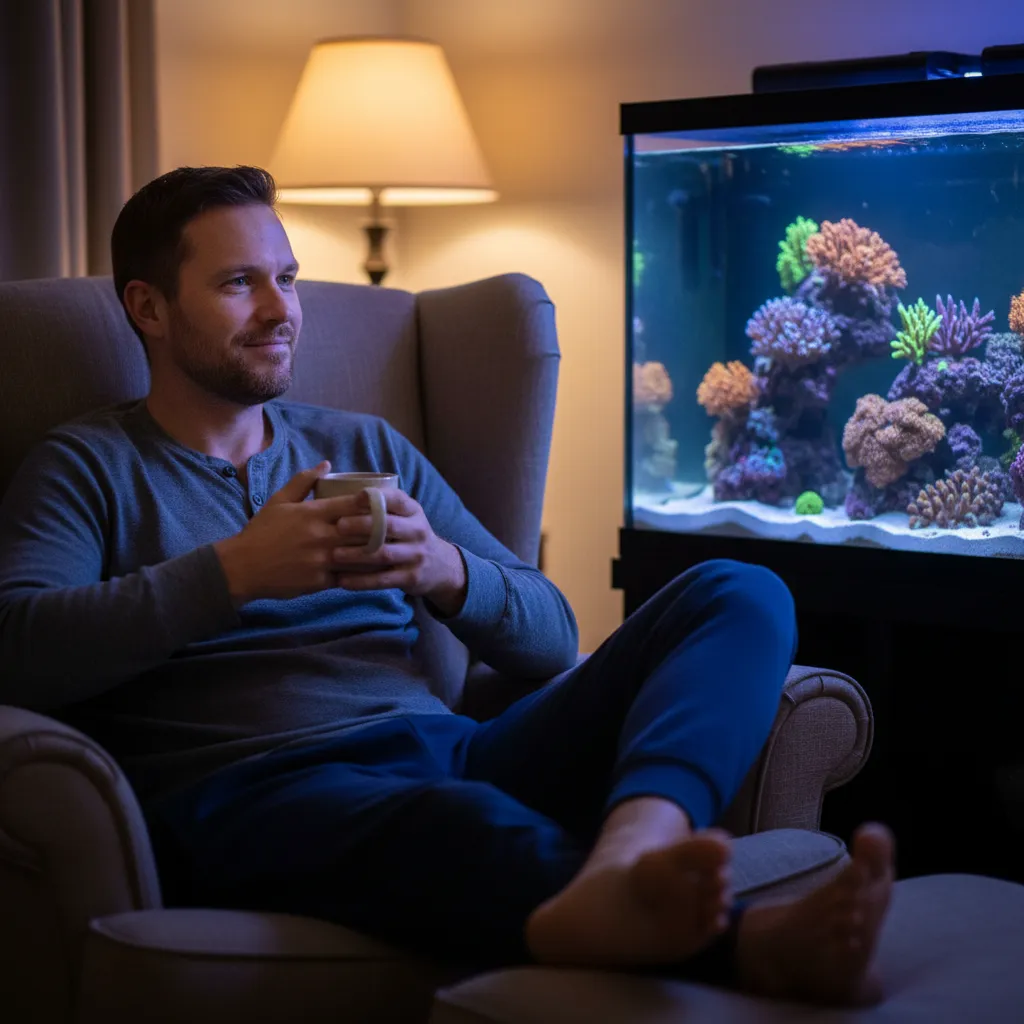
Best Reef Tank Lights for Beginners: Simple & Reliable Picks
The right light comes down to three things: it covers your tank, supports the corals you want, and doesn’t punish you for not knowing every spec.
⚡ TL;DR
The best reef tank lights for beginners balance adjustable intensity, adequate tank coverage, and blue-heavy spectrum output – not the highest price tag or most advanced specs. Most beginner-friendly corals like mushrooms, zoanthids, and leather corals thrive at 50–150 PAR, which mid-range LED fixtures in the $130–$350 range handle comfortably. Starting at 20–30% intensity and ramping up gradually over 6–8 weeks is the single most important setup practice for keeping new corals healthy.
Choosing the best reef tank lights for beginners doesn’t have to feel like studying for an engineering exam. The right light for your first tank comes down to three things: it covers your tank size, it supports the corals you want to keep, and it doesn’t punish you for not knowing every spec by heart.
This guide skips the jargon walls. You’ll get plain-English explanations, real product categories, and a clear path to your first confident lighting decision.
Why Reef Tank Lighting Feels So Overwhelming (And Why It Doesn’t Have to Be)
Most beginners hit the same wall: you search “reef tank light,” and within minutes you’re drowning in PAR charts, spectrum graphs, and forum debates that have been running since 2014. It’s not you. The reef hobby has a long tradition of overcommunicating technical detail to people who just want their corals to live.
Corals are photosynthetic animals. They need light to feed their symbiotic algae (called zooxanthellae), which in turn feeds the coral. Too little light and corals slowly starve. Too much, too fast, and they bleach. Your job as a beginner is to land somewhere in the middle – and stay consistent.
Most beginner-friendly corals – soft corals like mushrooms, zoanthids, and leather corals – are forgiving. They tolerate a wide range of light levels. That means your first light doesn’t need to be perfect. It needs to be good enough and consistent.
The specs that get hyped on forums (PAR numbers, spectrum tuning, nanometer wavelengths) matter more when you’re keeping demanding SPS corals like Acropora. You’re not there yet – and that’s completely fine. For the full picture, see the reef tank lighting guide.
What Should You Actually Look for in a Beginner Reef Light?
The single most important feature in a beginner reef light is adjustable intensity. You need to be able to start low and ramp up gradually as your corals adjust – a process called acclimation.
🔵 Spectrum
Blue light (420–460nm) drives coral photosynthesis. White adds color rendering. A light with both – ideally with separate controls – is all you need at beginner level. No UV, deep red, or exotic channels required yet.
⏱️ Controllability
A built-in timer and dimmer removes the biggest beginner mistake – full blast from day one. App-controlled lights with sunrise/sunset schedules are now common in the $100–$250 range.
📐 Coverage
Every light has a recommended coverage area. A light rated for 24″×24″ will underperform over a 48″ tank. Always verify manufacturer coverage specs against real user feedback – not just the spec sheet.
What You Can Safely Ignore (For Now)
| Feature | Beginner Relevance | Why It Can Wait |
|---|---|---|
| PAR meter readings | Low | Useful later for SPS; overkill for soft corals |
| Spectral data charts | Low | Trust proven community picks over charts |
| Wattage (raw) | Misleading | LED efficiency varies; wattage alone means little |
| Advanced AI modes | Low | Manual sunrise/sunset schedules work fine |
| Moonlight simulation | Cosmetic | Nice, but not a coral health factor |
Best Reef Tank Lights by Tank Size
The right light depends first on your tank size. Here are the categories that consistently perform well for beginners – matched to real tank footprints.
🐠 Nano Tanks (Under 20 Gallons)
For tanks in the 5–20 gallon range, compact clip-on or pendant-style LEDs work well.
- Kessil A80 Tuna Blue – compact, clean full-spectrum, simple dial control. ~$130–$150. Covers 12″×12″ well.
- AI Prime 16HD – app-based scheduling, large beginner community, real setup guides available. ~$180–$200.
🪸 Mid-Size Tanks (20–50 Gallons)
The most common beginner range – and the most competitive bracket for lights.
- Aqua Illumination Hydra 32 HD – covers 24″×24″, excellent app control, huge community. ~$280–$320.
- Radion XR15 G6 (EcoTech Marine) – professional build quality, myAI scheduling. ~$350–$400. A light many reefers keep for years.
- Kessil A360X – punches above its price for 30–50 gallon tanks, simple dial, no app needed. ~$250.
🌊 Larger Beginner Tanks (50–75 Gallons)
A single fixture rarely covers a 48″+ tank evenly. Plan for two units – or go bar-style.
- Two AI Prime 16HD or two Kessil A360X – proven dual-fixture configuration for 48″+ tanks.
- Aqua Illumination Blade – full-length bar-style, spans a standard 48″ tank cleanly.
- Reef Breeders Photon V2+ – strong value reputation for budget-conscious beginners. ~$250–$300.
How to Set Up and Program a Reef Light Without Overdoing It
⚠️ Start at 20–30% intensity.
This is the single most important setup instruction, and most beginners skip it because the manual doesn’t make it obvious enough. Before your light arrives, it’s worth running through a reef tank setup checklist so lighting is one coordinated step – not the first thing you’re scrambling to configure.
Week-by-Week Ramp Schedule
Use this as your starting point. If you see bleaching or excessive algae growth, back down.
| Week | Intensity | Photoperiod |
|---|---|---|
| Week 1–2 | 20–25% | 6 hours |
| Week 3–4 | 30–40% | 7–8 hours |
| Week 5–6 | 40–55% | 8–9 hours |
| Week 7–8 | 55–70% | 9–10 hours |
| Week 9+ | Adjust by coral response | 9–10 hours max |
Set a sunrise/sunset ramp. Program your light to ramp up over 60–90 minutes in the morning and ramp down the same way in the evening. This mimics natural light transitions and reduces coral stress. Most app-controlled fixtures make this a two-minute setup task. Never run a reef light more than 10–11 hours per day – longer photoperiods feed nuisance algae without benefiting corals.
Common Beginner Lighting Mistakes and How to Avoid Them
❌ Running lights at full intensity from day one
The most common and most damaging beginner error. Full-blast light on a stressed coral causes bleaching within 48–72 hours of arrival.
❌ Buying a light that’s too small for the tank
A light rated for 18″×18″ over a 36″ tank leaves the edges dim and creates uneven coral placement pressure. Check coverage specs before purchasing.
❌ Chasing PAR numbers without context
PAR measures light energy, but it doesn’t tell you whether a coral is happy. A mushroom coral at 50 PAR thrives. Acropora needs 200–400 PAR. Know your corals first.
❌ Inconsistent schedules
Corals have internal rhythms. Shifting your photoperiod by 2–3 hours randomly compounds stress over weeks. Set a schedule on day one and stick to it.
For a complete rundown of pitfalls beyond just lighting, see the guide on common reef tank mistakes beginners make.
Where to Go Next Once You’ve Got Your Light Dialed In
Once your corals are stable and your light schedule is running consistently for 8–10 weeks, you’re ready to expand. The logical next steps are water chemistry (calcium, alkalinity, magnesium) and your first LPS corals – Hammer coral or Torch coral.
LPS corals are the natural progression from soft corals. More visually dramatic, moderately demanding, and still well within the range of what a properly set beginner light can support. See the guide on best beginner corals for reef tanks for which species are most forgiving.
The best thing you can do right now: Resist the urge to change things once they’re working. A stable tank with a consistent light schedule, healthy soft corals, and clean water parameters is a genuinely successful reef. Let it run. Observe. Then level up deliberately.
❓ Frequently Asked Questions
What is the easiest type of reef tank light to set up for a first tank?
App-controlled LED fixtures – they let you program a sunrise-to-sunset schedule from your phone without manually adjusting anything daily. Brands like AI and Kessil have large beginner communities with published setup guides. A basic intensity ramp schedule and a consistent 8–10 hour photoperiod is all you need to configure on day one.
How much should a beginner spend on a reef tank light?
$130–$350 depending on tank size. Nano tanks under 20 gallons: $130–$200. Mid-size 20–50 gallon tanks: $250–$350. Spending more than $400 as a beginner is rarely necessary – those features only matter for demanding SPS corals.
What’s the difference between soft coral and SPS lighting requirements?
Soft corals thrive at 50–150 PAR and are forgiving for beginners. SPS corals like Acropora require 200–400 PAR with precise spectrum tuning. Start with soft corals and only upgrade when ready to move to SPS – usually after 12+ months of stable tank experience.
Can you over-light a reef tank?
Yes – excess light is one of the most common causes of coral bleaching in new tanks. Starting at 20–30% intensity and ramping up over 6–8 weeks gives corals time to acclimate and dramatically reduces bleaching risk.
How do you know if your reef tank light is strong enough?
Watch coral behavior, not just meter readings. Healthy corals show full polyp extension during the light period and maintain vibrant color. Consistently closed corals or pale tissue usually points to lighting or schedule issues before water parameters.
Does the color of reef tank light matter?
Yes. Reef corals rely on zooxanthellae algae driven most efficiently by blue wavelengths in the 420–460nm range. Freshwater LEDs and standard white grow lights lack this blue-heavy output – reef-specific fixtures are necessary, not optional.
How long does a reef tank LED light typically last?
Quality reef LEDs from reputable manufacturers last 5–8 years before diodes begin to degrade noticeably. LEDs dim gradually over thousands of hours – not suddenly. Keeping the fixture clean and ventilated extends lifespan and maintains consistent output.
Ready to Build a Thriving Reef from Day One?
Explore more beginner guides, gear reviews, and expert tips at The Reef Authority – built by reefers who’ve been exactly where you are.